
Small and medium-sized businesses waste 37% of their marketing budget on channels that don’t match their customer behavior, business model, or growth stage. Business owners face conflicting advice about digital marketing vs traditional marketing, with advocates on both sides claiming superiority. Without a clear framework to evaluate channels against your specific business variables, you risk misallocating resources. You also risk missing your best customers where they spend their time and attention.
This full guide provides a decision framework to help you determine your optimal marketing mix. It analyzes your industry, budget, audience demographics, and growth stage. You’ll learn the business variables that determine whether digital marketing vs traditional marketing delivers better results for your company. You’ll get practical ROI comparison tools. You’ll see exactly how to allocate your 2026 marketing budget based on proven testing protocols.
Digital Marketing vs Traditional Marketing: Business Variables That Determine Your Channel Selection
Your company’s size, audience, and industry shape whether digital marketing vs traditional marketing delivers better results.

Revenue Stage and Budget Thresholds for Channel Viability
Smaller businesses need different strategies than established companies. Businesses under $5M in revenue typically allocate 70-80% of their budget to digital channels. This is because of cost efficiency and precise measurement capabilities.
Companies exceeding $20M in revenue can dedicate 30-40% of their marketing budget to traditional channels. They have the resources to sustain longer-term brand-building campaigns. These campaigns use TV, radio, and print ads.

Customer Demographics and Media Consumption Patterns
B2B companies targeting decision-makers aged 45 and older see 3.2x better ROI from trade publications and direct mail. This compares to social media campaigns. These professionals still rely on established industry sources for purchasing decisions.
B2C brands targeting audiences under 35 require 85%+ digital presence. This demographic consumes content primarily through mobile devices and social platforms, which makes traditional channels less effective for reaching them. Digital strategies will increasingly use AI to personalize customer experiences. They’ll also optimize campaign performance.
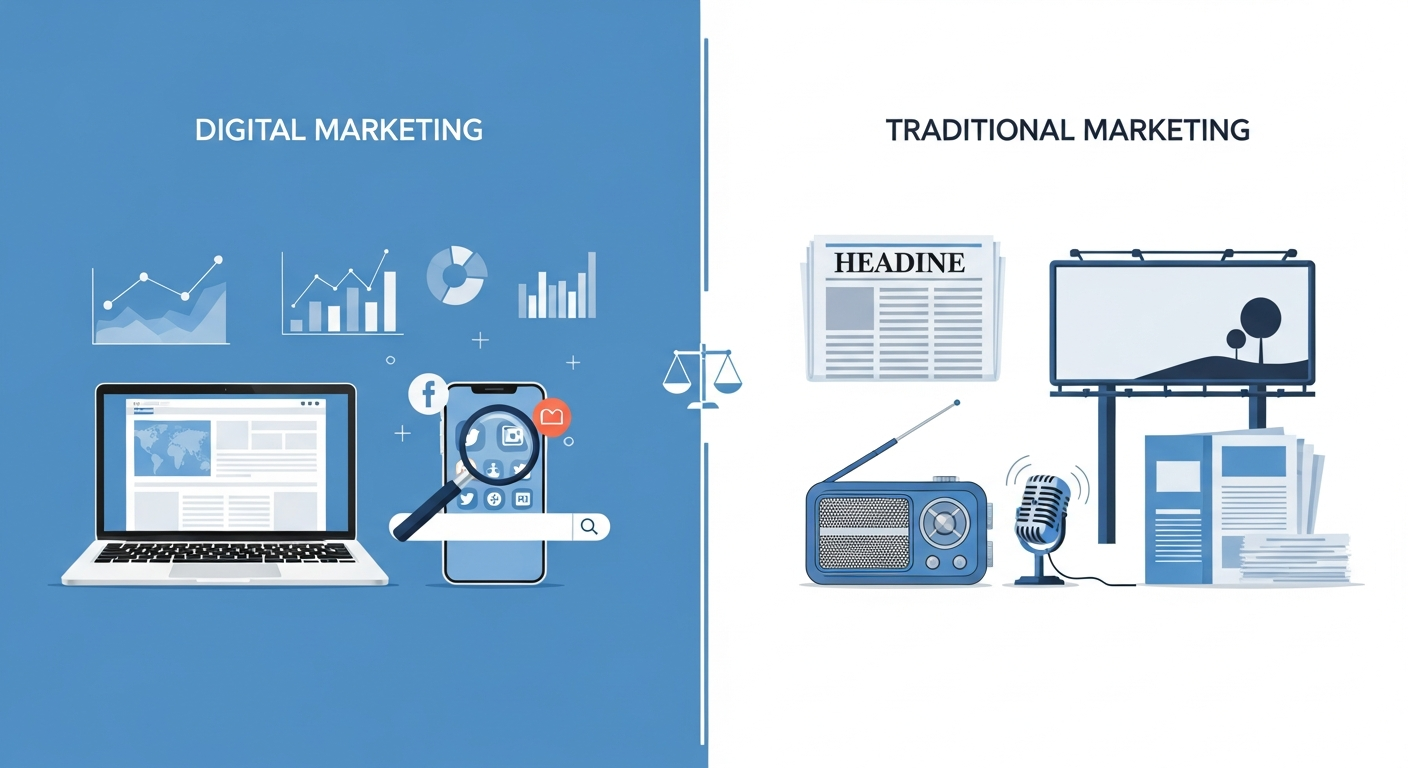
Industry-Specific Channel Performance Data
Local service businesses generate 60% of leads from Google Business Profile and local SEO. Dental practices, law firms, and home service companies find traditional yellow pages and newspaper ads obsolete in most markets.
Manufacturing and industrial sectors still capture 40% of qualified leads from trade shows and industry publications. These businesses need hybrid strategies combining both approaches. Hybrid strategies deliver 35% higher conversion rates than single-channel approaches. They capture buyers across research and evaluation stages. E-commerce businesses can maximize their digital marketing vs traditional marketing ROI by implementing conversion optimization strategies. These strategies incentivize customer purchases and increase conversion rates. Visit our e-commerce conversion guide for detailed tactics.
ROI Comparison Framework: Calculating True Cost Per Acquisition
Accurate attribution modeling becomes essential for modern businesses tracking their marketing investments. This applies across multiple customer touchpoints when evaluating digital marketing vs traditional marketing.
Digital Marketing Cost Structures and Attribution Models
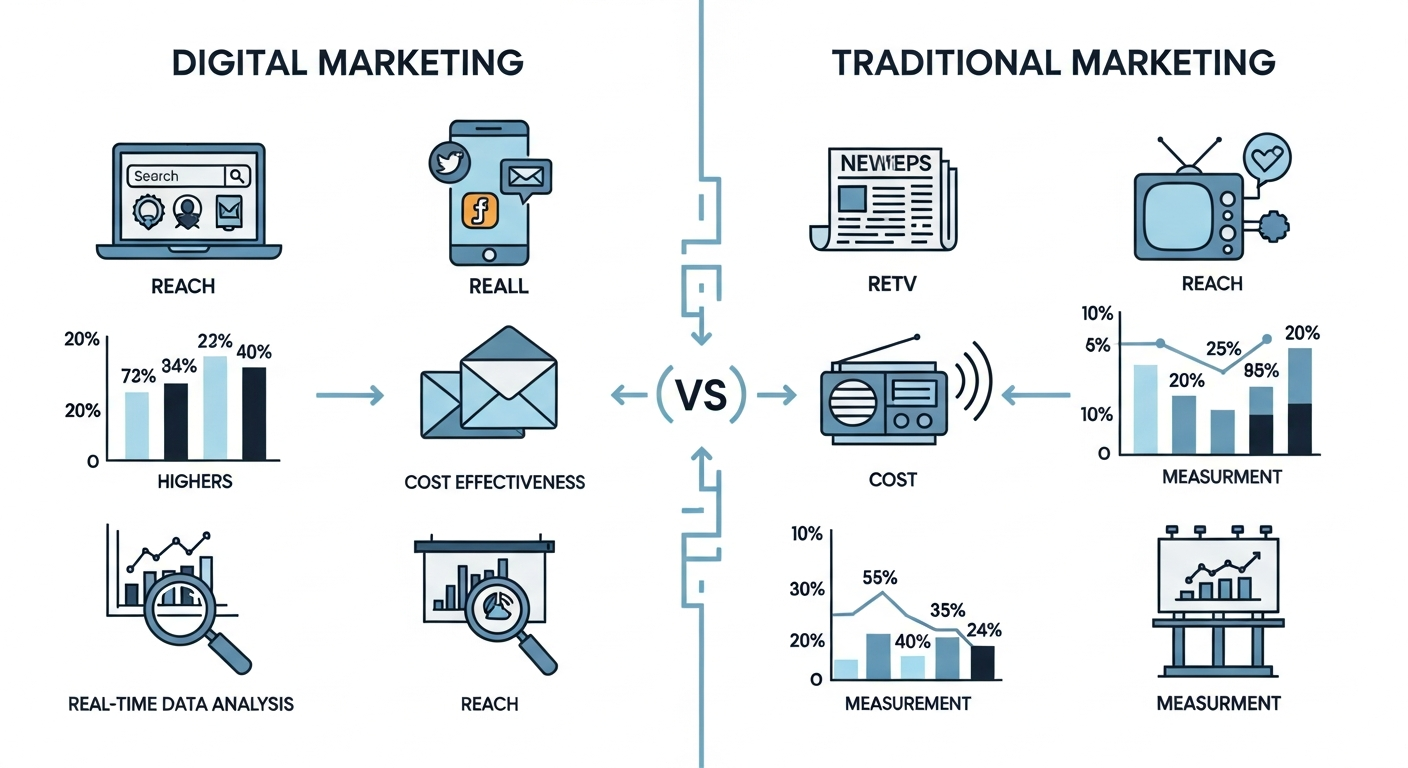
Digital channels deliver CPAs between $45-$150 for small businesses with proper optimization. Real-time tracking lets you adjust campaigns instantly. This reduces waste by 40-60%.
Attribution complexity creates measurement challenges. Multi-touch customer journeys mean reported CPAs often undercount actual costs by 15-30%. A customer might click three ads before converting. But only the last click gets credit.
Traditional Marketing Investment Requirements and Tracking Methods
Traditional campaigns require $5,000-$25,000 upfront with 3-6 month minimum commitments. Financial services and healthcare sectors see 25-35% higher trust scores from traditional channels. This justifies the investment. The American Marketing Association reports that 68% of marketers struggle with accurate ROI measurement across traditional channels.
Poor tracking methods lead to overcounting effectiveness by 20-40%. Without precise attribution, businesses struggle to separate organic growth from campaign impact.
Hidden Costs and Time-to-Result Factors
| Channel | CPA Range | Minimum Investment | Time to Results | Measurement Accuracy |
|---|---|---|---|---|
| Google Ads | $50-$200 | $1,000 | 1-2 weeks | 85-90% |
| Facebook Ads | $45-$150 | $500 | 1-2 weeks | 80-85% |
| SEO | $100-$300 | $2,000 | 3-6 months | 70-75% |
| Direct Mail | $200-$500 | $5,000 | 4-8 weeks | 50-60% |
| Radio | $300-$800 | $10,000 | 2-3 months | 40-50% |
| $250-$600 | $8,000 | 1-2 months | 35-45% | |
| Trade Shows | $400-$1,200 | $15,000 | 3-6 months | 60-70% |
Decision Trees for Three Common Business Scenarios
Your marketing budget allocation depends heavily on business stage and customer value. The digital marketing vs traditional marketing split shifts as companies mature. It also shifts as they target different customer segments.
Startup Launch Strategy: $50K-$250K First-Year Budget
Startups should allocate 85% to digital channels with focused distribution:
- 50% paid search for immediate lead generation
- 25% SEO and content marketing for long-term visibility
- 10% social media ads for brand awareness
- 15% targeted local sponsorships or direct mail for high-value prospect lists under 5,000 contacts
Growth Stage Expansion: $250K-$1M Marketing Investment
Growth-stage businesses perform best with a 70% digital, 30% traditional split. Add trade shows, industry publications, and strategic radio or podcast sponsorships. These build brand recognition beyond performance marketing alone.
Mature Business Optimization: $1M+ Multi-Channel Approach
Mature companies optimize with 60% digital and 40% traditional channels. Brand awareness campaigns through TV, radio, and outdoor ads reduce digital CPAs by 18-25%. This happens through improved recognition and trust.
Decision logic: If customer LTV exceeds $5,000 AND sales cycle exceeds 90 days, allocate 40% to relationship-building traditional channels. If LTV stays below $500 AND purchases are impulse-driven, invest 90%+ in digital performance marketing. This allocation approach aligns with fundamental business economics and customer acquisition dynamics. Monitor digital advertising spending trends to ensure your allocation remains competitive within your industry.
Building Your 2026 Marketing Mix: Allocation Models and Testing Protocols
Quarterly Budget Allocation Templates by Business Type
Allocate 80% of your budget to proven channels. Reserve 20% for testing new opportunities. Track cost per acquisition against your target from day one. Run tests for at least 90 days to gather meaningful data.
| Business Type | Primary Allocation | Secondary Focus | Testing Budget |
|---|---|---|---|
| E-commerce | 60% paid search/shopping, 20% SEO | 10% email/retention | 10% social/influencer |
| Professional Services | 40% SEO, 25% paid search | 20% content marketing | 15% speaking/publications |
| Retail/Restaurant | 35% local SEO/Google Business | 25% social, 20% email/loyalty | 20% local radio/direct mail |
Testing Framework for New Channel Introduction
Run new channels for minimum 90 days to gather meaningful data. Track cost per acquisition against your target from day one.
Performance Benchmarks and Adjustment Triggers
Set clear triggers. If channel CPA exceeds target by 25% for two months, cut allocation by 30%. When new channels beat benchmarks by 20%, increase budget by 50% next quarter.
Conclusion
The digital marketing vs traditional marketing debate isn’t about choosing sides. It’s about building the right mix for your specific business context. We’ve covered how business variables determine your channel selection. We’ve established ROI comparison frameworks for calculating true cost per acquisition. We’ve walked through decision trees for three common scenarios. We’ve provided allocation models with testing protocols for 2026.
The most important insight: businesses under $5M revenue need 70-85% digital allocation for cost efficiency. Larger companies benefit from 30-40% traditional investment for brand building. Your optimal digital marketing vs traditional marketing balance depends on your revenue stage, customer demographics, and growth objectives. It doesn’t depend on industry generalizations.
Start by calculating your current marketing mix. Compare it against the allocation models we’ve outlined. Identify your largest performance gap. Then reallocate 20% of that underperforming budget to your top-performing channel next quarter. Set clear cost per acquisition targets and adjustment triggers. Then review monthly to optimize based on actual results.
Visit wp.flolio.com for additional resources and analytical tools to support your marketing strategy refinement and decision-making process.
Frequently Asked Questions
What is the main difference between digital marketing vs traditional marketing?
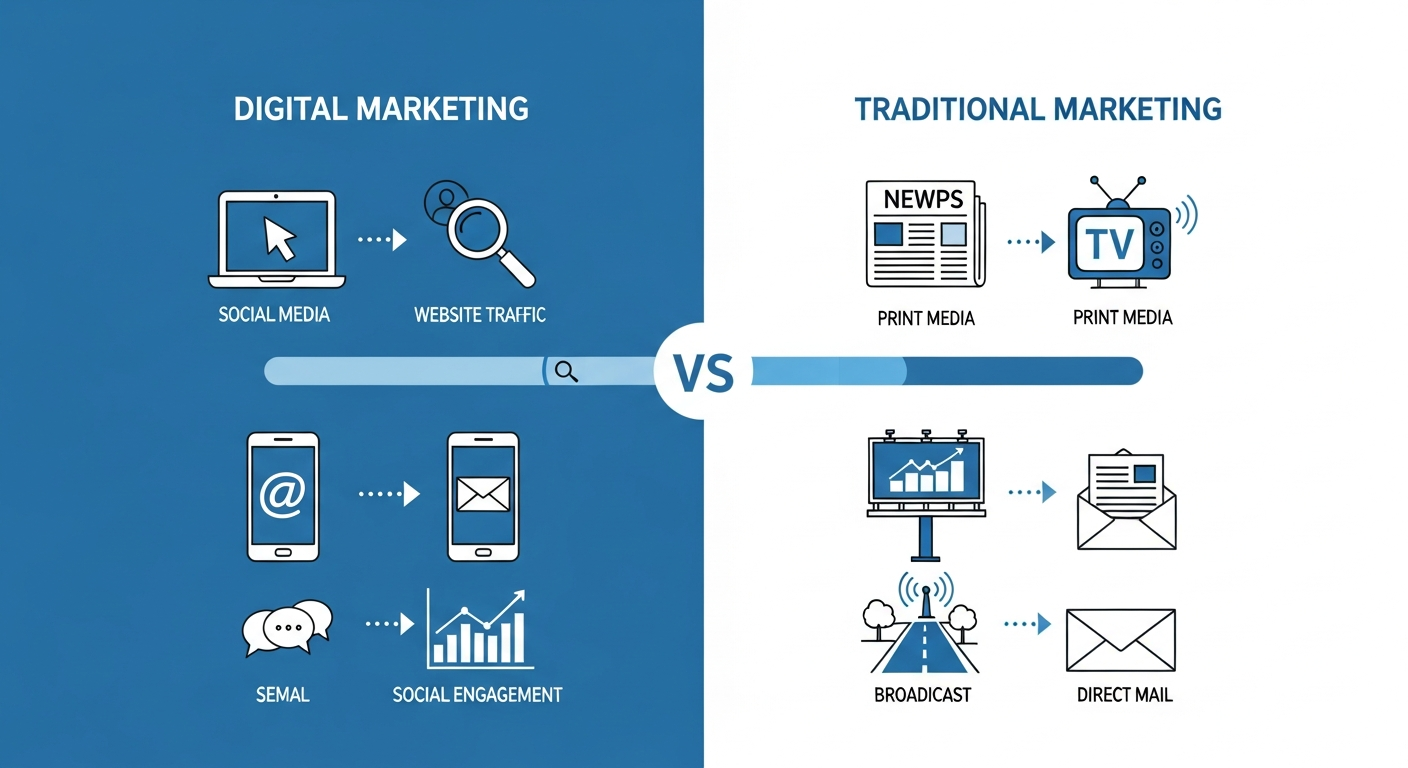
Digital marketing uses online channels like social media, search engines, and email. Traditional marketing relies on offline methods such as print ads, billboards, and television. The key distinction lies in targeting precision and measurement capabilities. Digital channels offer real-time analytics and audience segmentation. Traditional methods provide broader reach with less granular tracking. Cost structures differ greatly. Digital typically requires lower upfront investment but also ongoing optimization efforts.
Which marketing is better digital or traditional for small businesses?
The best marketing strategy for small business depends on your target audience demographics and budget constraints. Digital marketing typically offers better ROI for businesses with limited funds. You can start with minimal investment and scale based on results. However, local businesses targeting older demographics may benefit from traditional methods like direct mail or local newspaper ads. Most successful small businesses use a hybrid marketing strategy. They allocate roughly 70-80% to digital channels and maintain selective traditional touchpoints for community presence.
How should I allocate my marketing budget between digital and traditional channels?
Marketing budget allocation should follow the 80/20 testing framework: invest 80% in proven channels and reserve 20% for experimentation. Startups typically allocate 90-95% to digital channels for measurable growth. Established businesses might split 60-70% digital and 30-40% traditional. Your small business marketing mix should reflect where your customers spend time. It should also reflect which channels deliver the lowest cost per acquisition. Run tests for at least 90 days before making major reallocation decisions. You should adjust your strategy quarterly based on performance data.
How do I calculate digital vs traditional marketing ROI accurately?
Calculate true cost per acquisition by including all direct and indirect expenses. For digital, factor in ad spend, platform fees, content creation, and management time. Traditional marketing costs include production, placement, and estimated reach-to-conversion ratios. Track customer lifetime value against acquisition costs for each channel. Digital platforms provide direct attribution. Traditional channels require tracking mechanisms like unique phone numbers or promo codes. Compare both channels over identical timeframes. Ensure you account for the full customer journey across multiple touchpoints.
When should a business shift from traditional to digital marketing?
Shift toward digital when your target audience shows strong online engagement. Also shift when traditional channels show declining returns. Businesses should increase digital allocation when they need better tracking capabilities, tighter budget control, or faster campaign adjustments. However, complete abandonment of traditional marketing rarely makes sense. Instead, develop a marketing channel comparison framework that evaluates performance quarterly. Industries with older demographics or local service areas may maintain higher traditional spending. E-commerce and B2B companies typically prioritize digital channels from launch.
What are the hidden costs in digital marketing vs traditional marketing?
Hidden costs of digital marketing include ongoing optimization time, software subscriptions, content creation resources, and platform learning curves. Traditional marketing carries production fees, longer lead times, and limited flexibility for changes once campaigns launch. Digital requires continuous monitoring and adjustment. Traditional demands larger upfront commitments with less ability to pivot. Both channels need skilled personnel or agency support. Digital typically demands more frequent attention. Factor in testing budgets for digital and minimum placement commitments for traditional when calculating true investment requirements.